Home / User comments

Filter
Display

  • jbcherry - Monday, January 18, 2016 at 8:32:16 PM
    James
    You are quit right, most decent brasses will have received some fettling and finishing "by hand". I think the term "hand cut" or "tinker" should be kept for just those brasses that have been cut from sheet by saw, drill and file, without the use of casting or press tools. There will always be problems imposing an artificial order on something as diverse as horse brasses, not least the case of royalty and award brasses where a cast emblem is attached to a stamped back plate!
    John
  • Jamesblair - Monday, January 18, 2016 at 1:12:36 AM
    Jbcherry I do now see your point, and I agree that it is wrong to ascribe an item to a particular origin simply because it is hand made. Arguably, many brasses could be considered "hand made" in a sense, because both cast and stamped versions were often finished by hand.
  • Jamesblair - Monday, January 18, 2016 at 12:34:37 AM
    I have had this brass for over 10 years and not sure of its date; any ideas please?
  • Jamesblair - Monday, January 18, 2016 at 12:31:16 AM
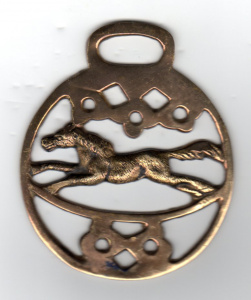
    a good quality example of this pattern. The motif of the running horse was very commonly used on the crown boards of bow top gypsy waggons. I think this brass dates from the 1920's - 1930's but would welcome opinions on the date.
  • Jamesblair - Monday, January 18, 2016 at 12:21:45 AM
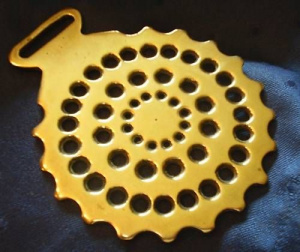
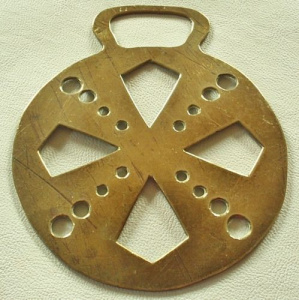
    This pattern, in white metal, was very typical of Gypsy van harness. Gypsies did not usually favour hanging brasses on their harness; it was usually decorated with studs, metal keepers, and horseshoe buckles, nearly always in white metal, and with these plain but elegant rosettes on the top of the bridle and often also as a face piece. They used white metal because it was easier to keep clean and looked better with the red patent leather decoration on the straps.
  • jbcherry - Thursday, January 7, 2016 at 10:27:57 AM
    Hi James
    I think you have missed my point, I have no opinion on what to call travellers and do not wish to get into that debate (nor is this the place).
    I have not said or implied the term 'Gypsy' is negative, please do not try and prove how PC you are by accusing me of crimes I have not committed.
    My point is that unless you have evidence that a specific brass was made by a traveller to assume it was, just because it is hand cut, is wrong. Even then, evidence that SOME such brasses were made by travellers does not mean they ALL were. Travellers do not have the monopoly on making things by hand and to assume so is offensive to the many other groups of skilled metalworkers. Assigning what is part of our common heritage to specific groups is as I said, at best, romantic tosh, at worst, racist.
  • jbcherry - Wednesday, January 6, 2016 at 8:29:30 PM
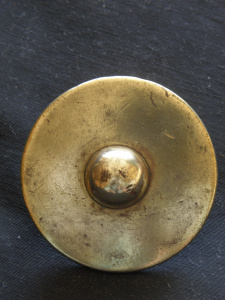
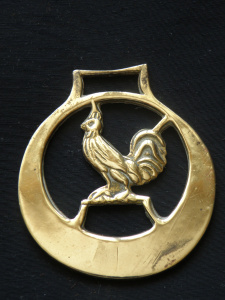
    This is interesting in that it is die cast, most brasses are cast in sand. whoever made the die put the vent and sprue holes on the front, rather than back or edge, very odd.
  • jbcherry - Wednesday, January 6, 2016 at 8:06:08 PM
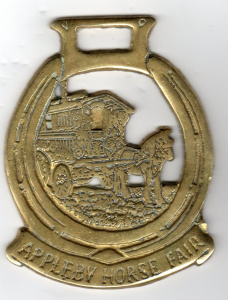
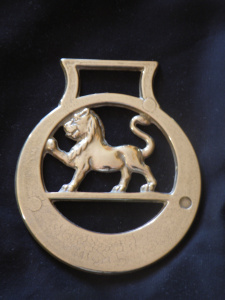
    This is a pressed brass, though there are also cast versions. It is small, lightweight and I guess not particularly old. There are others in the same style ie a lion. Possibly it was made as a promotional item. Does anyone know by who, when and how many are in the series?
  • Jamesblair - Sunday, January 3, 2016 at 1:50:02 AM
    I see there is still some controversy over what to call these brasses.
    I do not agree that the term "Gypsy" is necessarily negative; many Gypsies are very proud of the name, though some do view it as derogatory. The generally accepted "PC" term nowadays is "Traveller", reflecting the fact that the modern travelling community comprises a number of diverse elements who share a common lifestyle. Travellers to whom I have shown examples of these hand made brasses have confirmed to me that their forbears did make them, and it only died out in the '50's, when motor vehicles supplanted the horse.
    Whether an individual brass was made by English Romany, Irish Traveller (tinker)or travellers with no origins in these groups is impossible to say, and is in any case immaterial: they remain a surviving part of the history and heritage of the travelling community.

    Therefore I would suggest we call them Traveller Brasses.
  • jbcherry - Thursday, December 3, 2015 at 9:47:43 AM
    I prefer the name 'tinker' but 'hand cut' is less contentious. Either would be OK. The other name sometimes used is 'gypsy' but I think that is a bad name as it infers knowledge of the maker that we no longer have. An itinerant metalworker is a tinker but a tinker is not necessary a gypsy. To assume all such brasses were made by gypsies is at best romantic tosh, at worst, racist.